

In 2021, in the EU, almost seven in ten people aged 16 or over rated their health status as good or very good (69%). The positive perception of health was better among males than females (72% of males compared with 67% of females).
Among the EU Member States, the highest shares of the population aged 16 or over who perceived their health as good or very good were recorded in Ireland (81%), ahead of Greece (78%), Cyprus and Luxembourg (both 77%). At the other end of the scale, the EU Member States with the lowest shares were Lithuania (48%), Latvia and Portugal (both 50%).
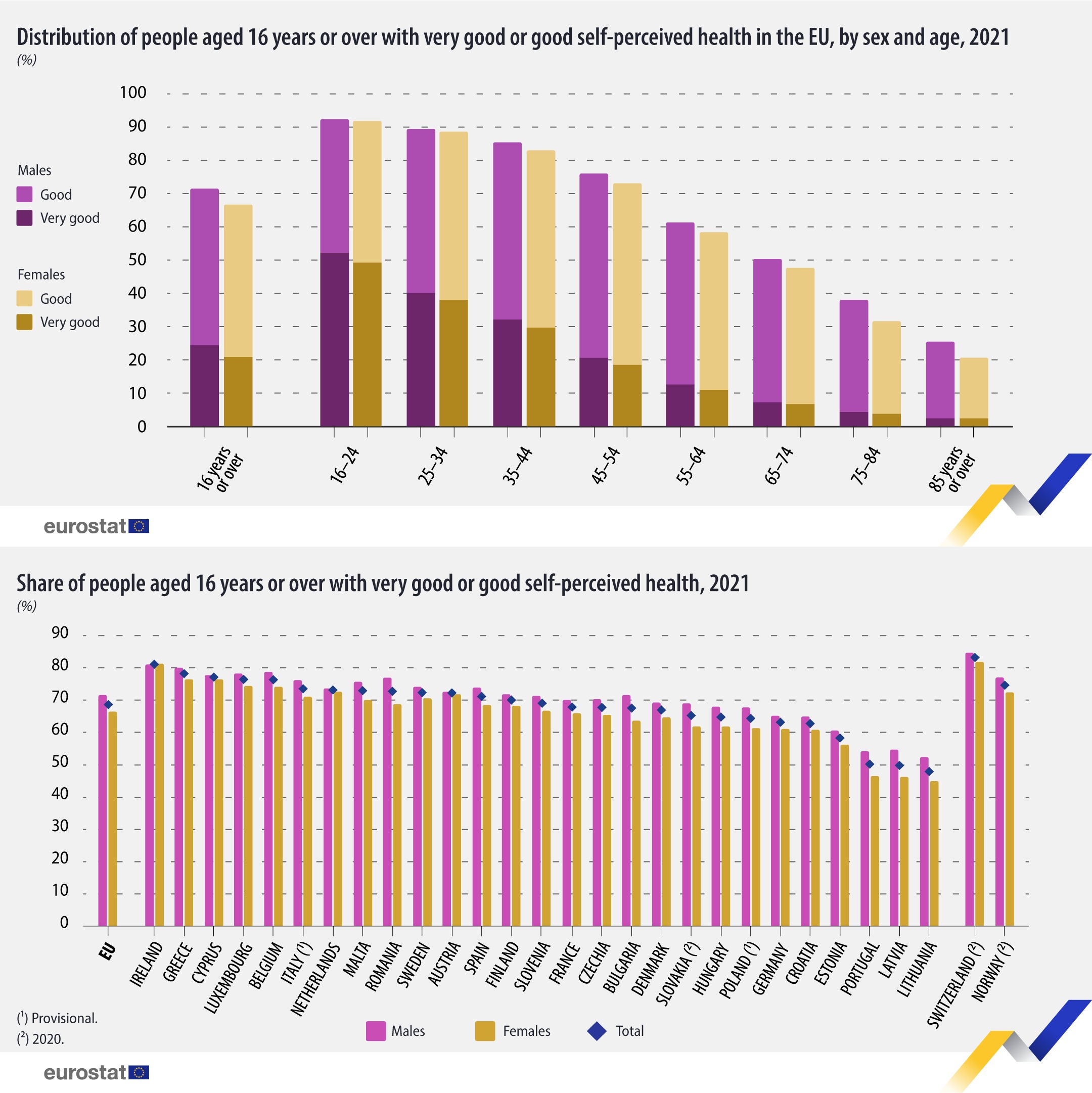
Males were more likely than females to rate their health as very good or good in nearly all of the EU Member States. The largest gender health gaps were recorded in Latvia (9 percentage points; pp), Romania (8 pp) and Lithuania (7 pp). The only exception was Ireland, where the share of females who reported having good or very good health was slightly higher than the share of males (0.4 pp).
Gender health gap increased with age
In the EU, in 2021, the share of people reporting good or very good health decreased with age.
The gender health gap widened with age: it was lowest for the populations aged between 16 and 24 and between 25 and 34 years (0.7 and 0.5 pp, respectively) and was highest for the two oldest age groups: a 6.3 pp gap for people aged 75–84 years and a 5.0 pp gap for people aged 85 years and over.